Study Abroad from Bangladesh: Complete Guide

In 2026, the path to international higher education requires more financial preparation and earlier planning than ever before for a Bangladeshi student deciding to study abroad. The entire preparation process, spanning roughly 12-18 months, involves securing an admission offer from a foreign university, passing an English-language test, demonstrating sufficient financial savings, and obtaining a student visa before the chosen university intake.
- Rising Costs: Destination countries demand proof of 15 to 25 Lakh BDT for yearly living expenses alone, excluding tuition.
- Early Preparation: Systemic planning must start a full year before the university application deadlines.
- IELTS Standards: Strong language test scores remain essential for both university entry and visa approval.
- Flawless Bank Documents: Financial accounts must show clean histories without sudden, unexplained large cash deposits.
The Study Abroad Process from Bangladesh: Step by Step
1.Self-Assessment: Define goals, degree level, and funding sources. The very first action is looking inward. A student needs to decide the degree level, such as a bachelor's or master's program. Families must have a very open conversation about the total budget available. Knowing whether the family can comfortably afford 15 Lakh BDT per year or 40 Lakh BDT per year instantly narrows down the realistic options.
2.Research Countries and Universities: Find the right academic and financial fit. Determining the best countries to study abroad from Bangladesh depends entirely on the budget and long-term career plans. Students should look for university programs that match their previous academic background. Changing fields completely (for example, moving from a literature bachelor's to a computer science master's) often raises red flags for visa officers.
3.Estimate the Total Cost: Calculate beyond just tuition fees. Students must calculate the first year's tuition, the mandatory living cost proof required by the embassy, health insurance fees, and initial travel expenses. Documenting these costs early prevents unpleasant surprises when it is time to apply for the visa.
4.Prepare for Tests and Documents: Gather scores, transcripts, and letters. This phase involves registering for an English proficiency test like IELTS or PTE. While studying for the test, applicants should gather their academic transcripts and certificates. This is also the time to write a Statement of Purpose (SOP)—a personal essay explaining why the student chose this specific course—and collect Letters of Recommendation (LOR) from previous teachers or employers.
5.Apply for Scholarships and Funding: Seek out financial support early. If the budget is tight, students must look for government grants, university-specific merit awards, or external funding options. Scholarship deadlines often close months before standard university application deadlines.
6.Apply to Universities: Submit applications to chosen institutions. With all documents ready, students submit applications directly through the official university websites. Most institutions charge an application fee ranging from 5,000 to 15,000 BDT. Applying to three or four carefully chosen universities is usually a safe strategy.
7.Complete Admission and Prepare Visa Documents: Accept the offer and organize bank statements. Once a university sends an unconditional offer letter, the student usually must pay a tuition deposit to secure the seat. After this payment, the university issues a final official document needed for the visa, such as a Confirmation of Acceptance for Studies (CAS) in the UK or a Provincial Attestation Letter (PAL) in Canada. Simultaneously, the family must prepare their bank statements to prove they have the required living costs.
8.Apply for the Visa: Submit the application to the embassy. Applying for a student visa from Bangladesh involves filling out the immigration forms, paying the visa processing fee, submitting biometric data at a local application center, and waiting for the embassy's decision. The visa officer will review the academic history, financial proof, and overall intent to study.
9.Prepare for Travel and Student Life: Open a student file and book flights. After receiving the visa approval, the final steps involve booking airline tickets, arranging initial accommodation, and opening a Student File at a Bangladeshi bank to legally transfer the remaining tuition and living funds abroad.
Which Countries Do Bangladeshi Students Most Often Choose?
(Disclaimer: All financial figures are estimated based on 2026 policies. Currency exchange rates fluctuate constantly. Students must verify exact amounts directly through official university and government immigration websites before making any financial commitments.)
How Much Does It Cost to Study Abroad from Bangladesh?
Calculating the exact study abroad cost from Bangladesh means looking at five separate spending categories in the chronological order you will encounter them.
(Disclaimer: All financial figures are estimated based on 2026 policies. Currency exchange rates fluctuate constantly. Students must verify exact amounts directly through official university and government immigration websites before making any financial commitments.)
1. Application and Testing Costs
Before submitting any university applications, students face upfront expenses. For standardized tests like the IELTS exam, the registration fee in Bangladesh is currently around 29,000 BDT. For graduate programs, the GRE exam costs 220 USD (approximately 26,000 to 27,000 BDT), and the GMAT costs around 32,500 BDT. Furthermore, university application fees generally range from 5,000 to 15,000 BDT per institution.
Sending physical documents to foreign universities also adds up. Standard mailing through Bangladesh Post (EMS/Airmail) or local express couriers like ICS Express costs between 1,000 and 3,000 BDT. This is budget-friendly but lacks reliable tracking for strict deadlines. For safer door-to-door tracking, international couriers like DHL or FedEx charge between 5,500 and 8,000 BDT per package. Students must also authenticate their academic documents at the Education Board, the Ministry of Education, and finally the Ministry of Foreign Affairs (MOFA) in Dhaka. While MOFA attestation is formally free for students, Education Board verification usually costs between 300 and 500 BDT per certificate.
2. Financial Setup and Bank Account Fees
Transferring money internationally requires opening a "Student File" at a Bangladeshi commercial bank. Banks typically charge a file opening and maintenance fee of 5,000 to 9,000 BDT.
For students going to Germany, setting up a "Blocked Account" is a mandatory step. A Blocked Account is a restricted bank account mandated by the German government in which the student deposits their required living funds but can only withdraw a strict monthly maximum to pay for rent and groceries. Digital providers handle this setup. In 2026, Expatrio charges an initial setup fee of 89 to 119 Euros (approximately 11,500 to 15,500 BDT), while Fintiba charges a 159 Euro setup fee (approximately 20,600 BDT).
3. Living Expenses and Visa Financial Proof
Immigration departments ask students to prove they can survive without working illegally. Canada asks international students to show 22,895 CAD (approximately 20 Lakh BDT) for their first year of living expenses. Australia sets its minimum savings requirement at 29,710 AUD (approximately 23.7 Lakh BDT). Germany mandates depositing 11,904 Euros (approximately 15.7 Lakh BDT) directly into the Blocked Account. The UK requires proof of up to 13,761 GBP (approximately 21.7 Lakh BDT) for London, or 10,539 GBP (approximately 16.6 Lakh BDT) outside London.
4. Flights and Initial Setup
A one-way flight from Dhaka to North America currently costs between BDT 81,000 and 1.8 Lakh. Flights to Europe or Australia generally cost between 80,000 and 1.3 Lakh BDT. Students also need roughly 1 Lakh to 2 Lakh BDT in cash for their first month of rent deposits, winter clothing, and basic household items immediately upon arrival.
5. Tuition Fees
Tuition varies based on the destination and the program. Public universities in Germany charge practically zero tuition, requiring only a small semester contribution of roughly 30,000 to 50,000 BDT (250 to 400 Euros). In contrast, universities in the UK, USA, Canada, and Australia charge approximately 22 Lakh to 65 Lakh BDT per year. Some universities ask for a partial tuition deposit before issuing the final visa documents, while others collect the full balance after the student arrives.
Do You Need IELTS to Study Abroad from Bangladesh?
Many applicants look for ways to study abroad without IELTS from Bangladesh. While alternatives like Duolingo or the Pearson Test of English (PTE) are acceptable at some universities, or a Medium of Instruction (MOI) certificate from a past English-medium school can secure an offer letter, skipping language tests completely restricts access to top English-speaking destinations.
For those avoiding IELTS, non-English speaking countries are a practical choice. Japan does not legally mandate IELTS for its student visa. If a Japanese university accepts an international applicant via an internal interview or an MOI document for an English-medium degree, the embassy processes the visa without standard language test scores. However, if choosing a Japanese-medium course, a basic Japanese proficiency test score like JLPT N5 is mandatory. Similarly, public universities in Germany, China, and Malaysia frequently grant admission based on institutional interviews or MOI letters.
Even with these exceptions, taking the IELTS remains the most reliable pathway. Major destinations like Canada, Australia, and the UK expect formal testing for high visa approval rates. A minimum overall band score of 6.0 is standard for bachelor's degrees, while master's programs typically require a 6.5 or 7.0 score.
What About Scholarships?
Scholarships for Bangladeshi students are highly competitive but entirely possible for those with strong academic records. Financial aid generally falls into two categories: government-funded options and university-specific awards. Fully funded government programs, such as the Commonwealth Scholarship in the UK, the Fulbright Program in the USA, or the DAAD scholarships in Germany, cover full tuition, living stipends, and even return flights.
Many universities also offer partial merit scholarships that automatically reduce tuition by 10% to 30% based on high school grades or previous university results. Furthermore, students can explore the Lattu Launchpad Grant, along with other private grants specifically designed to support international education for South Asian applicants. Find out more scholarship information in our scholarship hub.
How Long Does the Whole Process Take?
Knowing when to start study abroad planning Bangladesh is the first step of a successful application. Moving from the initial idea to sitting in a foreign classroom takes twelve to eighteen months of steady work.
Important Note for Business and STEM Applicants: If aiming for top-tier global universities that ask for GMAT or GRE scores, the schedule shifts backward. These applicants must begin their test preparation at least one full year ahead—with a bare minimum of six months—to allow enough time for retakes and score reporting before application portals even open.
Months 1 to 3: Initial Setup and Test Preparation
Applicants select their target countries, establish the family budget, and begin intensive language test preparation.
Months 4 to 6: Examination and Documentation
Students take their official IELTS exam and request academic transcripts from their schools or universities. They also draft their Statement of Purpose during this window.
Months 7 to 9: University Applications
Portals open, and applicants submit their completed forms directly to target institutions. Universities usually take four to eight weeks to issue admission decisions.
Months 10 to 12: Financial Settlement and Visa Submission
Once an admission offer arrives, the family pays the tuition deposit and organizes the formal bank statements. The student then submits their application for a student visa from Bangladesh, which can take anywhere from three weeks to three months to process depending on the destination.
Bangladesh-Specific Things to Know
The Student File Requirement
The Central Bank of Bangladesh regulates how much foreign currency can leave the country. To send tuition and living costs abroad legally, a student or their parents must open a Student File at a recognized commercial bank in Bangladesh. The bank will ask for the unconditional admission letter, original passport, and later, the valid visa. Without a Student File, transferring large sums of money in foreign currency is virtually impossible.
Before reaching that stage, applicants face smaller payment hurdles. Paying university application fees requires a dual-currency credit or debit card. To activate the foreign currency portion of the card, a student must have their valid passport officially endorsed by their local bank.
A very common roadblock occurs when the initial university fee exceeds 30,000 BDT. Due to local banking limits on international online card payments, transactions above this amount often fail. Because students cannot open a full Student File without a final admission letter, they frequently get stuck trying to pay these mid-sized deposits. To solve this, applicants usually have to ask relatives with foreign credit cards to make the payment for them or rely on approved international transfer networks. Planning for this exact payment bottleneck keeps students from missing strict university deadlines
Document Attestation
Many European countries require academic documents to be formally authenticated. This means a student's Secondary School Certificate (SSC) and Higher Secondary Certificate (HSC) must be verified by the respective Education Board, the Ministry of Education, and finally the Ministry of Foreign Affairs (MOFA) in Dhaka before the embassy will accept them.
Strict Source of Funds Scrutiny
Visa officers pay very close attention to bank statements from Bangladesh. Sudden, unexplained large deposits look suspicious and often lead to immediate visa refusal. The money must show maturity. For example, the UK requires funds to sit untouched in an account for at least 28 consecutive days. If parents are funding the education through a business, they must provide valid trade licenses, tax returns, and audit reports to prove the income is legitimate.
Common Mistakes to Avoid When Planning to Study Abroad from Bangladesh
Applying Too Late: Missing intake deadlines means waiting an entire year for the next opportunity. Starting the application just three months before classes begin leaves zero room for visa processing delays. This applies to both universities and scholarships.
Ignoring the Exact Financial Rules: Assuming that simply having a rich relative is enough to secure a visa is a major error. Embassies want liquid cash in specific accounts, not just property valuations or vague sponsorship letters.
Choosing Mismatched Courses: Applying for a business degree after studying purely biological sciences without a clear, logical explanation raises doubts about the applicant's genuine intent to study.
Relying on Outdated Advice: Immigration rules change constantly. A financial requirement that worked for a friend in 2023 will not work in 2026.
How Lattu.ai Can Help
Frequently Asked Questions
Written by
Related Articles

How to Choose the Right Country for Higher Studies from Bangladesh
To find the right country to study abroad, you must first create a list of priorities for your career plan, budget, and educational background before looking at destination popularity. This guide gives you a step-by-step system to filter ou
 Lamisa Saba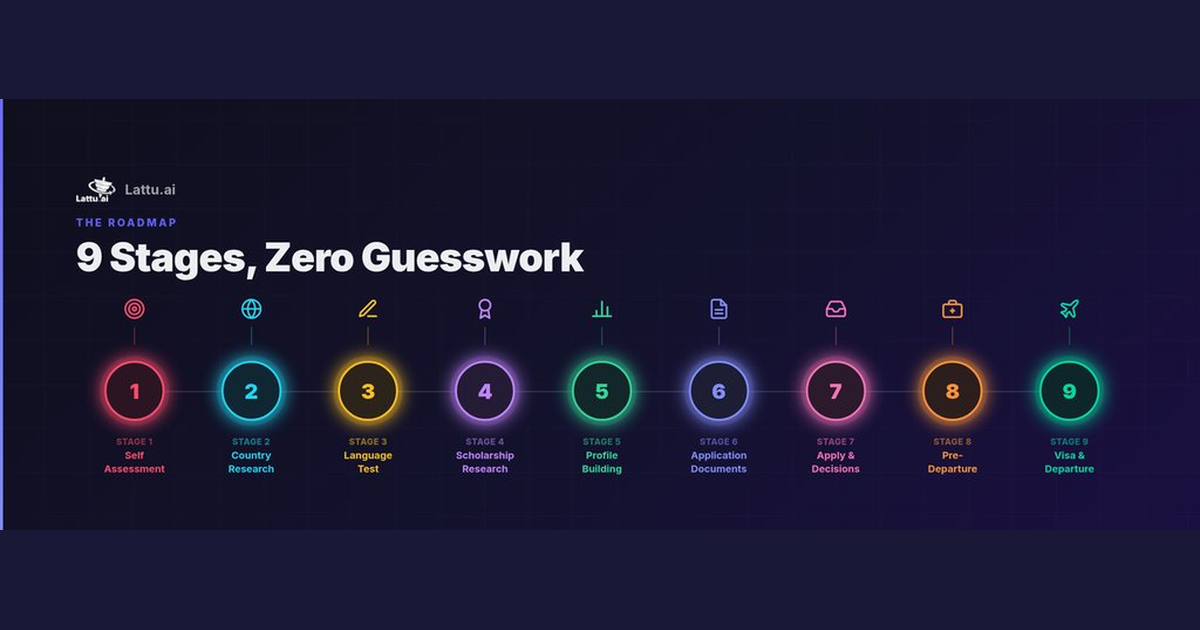
How to Plan Your Study Abroad Journey: A Step-by-Step Roadmap (2026)
To plan your study abroad journey from Bangladesh, you must follow a strict, sequential roadmap over 12 to 18 months to complete local document verification and clear embassy backlogs. Treating this timeline like a last-minute sprint is the
Lamisa Saba
Best Countries for Bangladeshi Students to Study Abroad in 2026
Picking the perfect country to study abroad isn't about looking at a single global ranking list. The right choice depends entirely on your specific budget, your academic grades, and what you want for your future career or immigration goals.
Lamisa SabaStay updated
Get new articles and scholarship alerts straight to your inbox.